Domain honigbienen.de kaufen?
Wir ziehen mit dem Projekt
honigbienen.de um.
Sind Sie am Kauf der Domain
honigbienen.de interessiert?
domain@kv-gmbh.de · 0541-91531010
Domain honigbienen.de kaufen?
Wie kann man Java-Variablen in einer XML-Datei aufrufen?
Java-Variablen können nicht direkt in einer XML-Datei aufgerufen werden, da XML eine reine Datenstruktur ist. Allerdings können Java-Programme XML-Dateien einlesen und die enthaltenen Daten in Variablen speichern. Dazu kann man eine XML-Parser-Bibliothek wie DOM oder SAX verwenden, um die XML-Datei zu analysieren und die gewünschten Daten in Java-Variablen zu extrahieren. **
Wie viele Honigbienen können in einem Bienenstock leben? Welche Rolle spielen Honigbienen in der Bestäubung von Pflanzen?
Ein Bienenstock kann bis zu 80.000 Honigbienen beherbergen. Honigbienen spielen eine wichtige Rolle bei der Bestäubung von Pflanzen, indem sie Pollen von einer Blüte zur nächsten übertragen und so zur Fortpflanzung und Fruchtbildung beitragen. Ohne Honigbienen würden viele Pflanzen nicht bestäubt werden und somit auch keine Früchte oder Samen produzieren. **


Ähnliche Suchbegriffe für Springer-Java-XML-and
Top-Angebote
Produkte zum Begriff Springer-Java-XML-and:
-
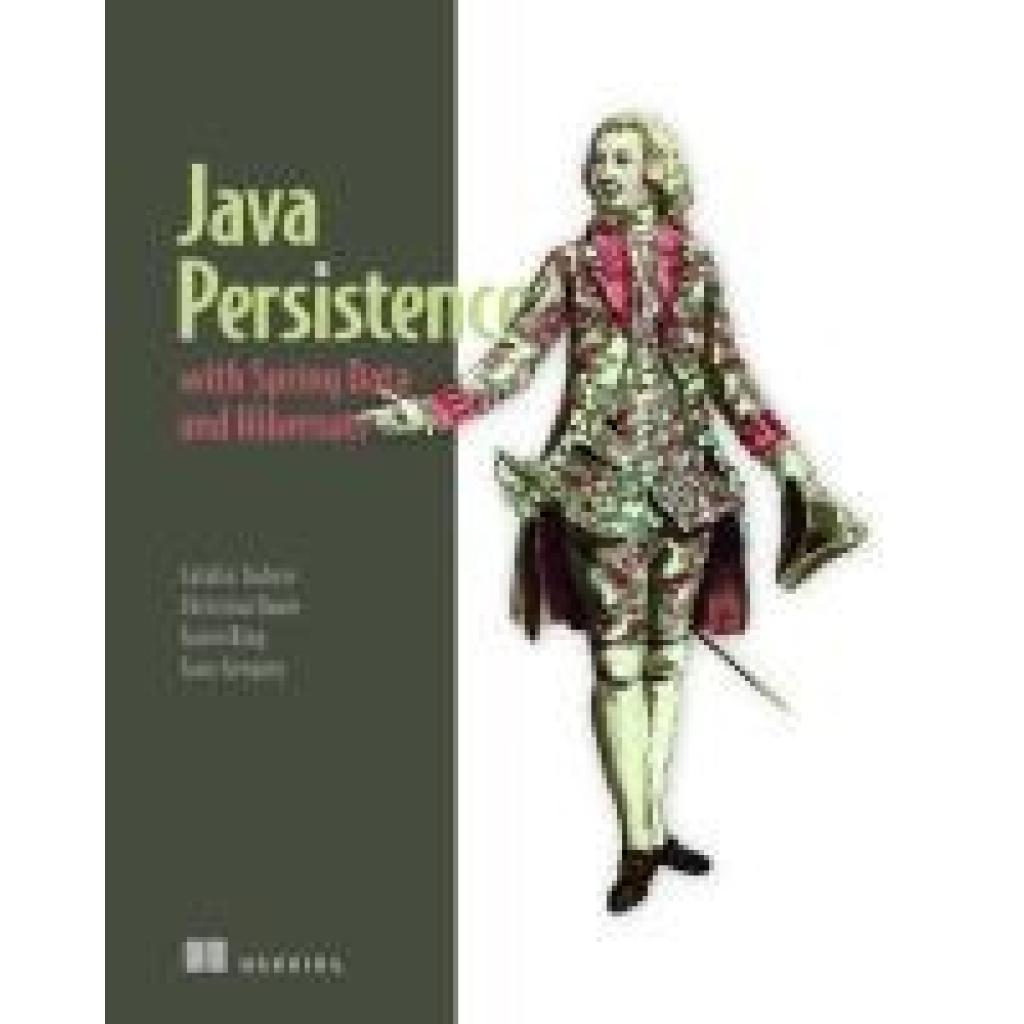
Tudose, Catalin: Java Persistence with Spring Data and HibernateJava Persistence with Spring Data and Hibernate , Master Java persistence using the industry-leading tools Spring Data and Hibernate. In Java Persistence with Spring Data and Hibernate you will learn: Mapping persistent classes, value types, and inheritance Mapping collections and entity associations Processing transactions with Spring Data and Hibernate Creating fetch plans, strategies, and profiles Filtering data Building Spring Data REST projects Using Java persistence with non-relational databases Querying JPA with QueryDSL Testing Java persistence applications Java Persistence with Spring Data and Hibernate teaches you the ins-and-outs of Java persistence with hands-on examples using Spring Data, JPA, and Hibernate. The book carefully analyzes the capabilities of the major Java persistence tools, and guides you through the most common use cases. By comparing and contrasting the alternatives, you’ll find it easy to choose the right tool choice for your applications. You’ll learn how to make and utilize mapping strategies, about the different approach to transactions for both Hibernate and Spring Data, and even how to efficiently test Java persistence applications. The practical techniques are demonstrated with both relational and non-relational databases. Forewords by Dmitry Aleksandrov and Mohamed Taman. Purchase of the print book includes a free eBook in PDF, Kindle, and ePub formats from Manning Publications. About the technology Effectively managing application data is essential for any serious application. Spring Data and Hibernate bridge the gap between object-oriented code and relational data stores, radically simplifying Java persistence. By implementing the Java Persistence API (JPA) standard, these powerful tools help you avoid common bugs related to state and application data storage. About the book Java Persistence with Spring Data and Hibernate explores Java persistence using industry-standard tools. Hands-on examples introduce object-relational mapping and guide you through different mapping strategies to suit your needs. Covering transactions, persistent application testing, and non-relational databases, this book is your go-to resource for managing data in Java applications. What's inside Mapping persistent classes, value types, and inheritance Creating fetch plans, strategies, and profiles Building Spring Data REST projects Querying JPA with QueryDSL About the reader For intermediate Java programmers. About the author Catalin Tudose has more than 20 years of experience in the Java community. Christian Bauer , Gavin King , and Gary Gregory are the authors of Java Persistence with Hibernate, Second Edition , on which this book is based. Table of Contents PART 1 - GETTING STARTED WITH ORM 1 Understanding object/relational persistence 2 Starting a project 3 Domain models and metadata 4 Working with Spring Data JPA PART 2 - MAPPING STRATEGIES 5 Mapping persistent classes 6 Mapping value types 7 Mapping inheritance 8 Mapping collections and entity associations 9 Advanced entity association mappings PART 3 - TRANSACTIONAL DATA PROCESSING 10 Managing data 11 Transactions and concurrency 12 Fetch plans, strategies, and profiles 13 Filtering data PART 4 - BUILDING JAVA PERSISTENCE APPLICATIONS WITH SPRING 14 Integrating JPA and Hibernate with Spring 15 Working with Spring Data JDBC 16 Working with Spring Data REST PART 5 - BUILDING JAVA PERSISTENCE APPLICATIONS WITH SPRING 17 Working with Spring Data MongoDB 18 Working with Hibernate OGM PART 6 - WRITING QUERIES AND TESTING JAVA PERSISTENCE APPLICATIONS 19 Querying JPA with Querydsl 20 Testing Java persistence applications , > , Erscheinungsjahr: 20230213, Produktform: Kartoniert, Autoren: Tudose, Catalin~Bauer, Christian~King, Gavin, Seitenzahl/Blattzahl: 562, Themenüberschrift: COMPUTERS / Databases / General~COMPUTERS / Programming / Object Oriented~COMPUTERS / Programming Languages / Java, Keyword: JPA; REST; JDBC; QueryDSL; object relational mapping; querying; non-relational databases; testing; fetch plans; profiles; entity associations; inheritance, Fachschema: Objektorientiert (EDV)~Microsoft SharePoint (WebServices, Portal)~Web Services (EDV)~Programmiersprachen~Database~Datenbank~Intelligenz / Künstliche Intelligenz~KI~Künstliche Intelligenz - AI~Übersetzung, Fachkategorie: Objektorientierte Programmierung (OOP)~Programmier- und Skriptsprachen, allgemein~Datenbanken~Natürliche Sprachen und maschinelle Übersetzung, Warengruppe: HC/Programmiersprachen, UNSPSC: 49019900, Warenverzeichnis für die Außenhandelsstatistik: 49019900, Länge: 233, Breite: 187, Höhe: 35, Gewicht: 1162, Produktform: Kartoniert, Genre: Importe,53,99 €*Versand: 0,00 €Sichere Weiterleitung zum Anbieter



-
"Was sind die wichtigsten Aufgaben von Honigbienen in einem Bienenstock?" "Wie tragen Honigbienen zur Bestäubung von Pflanzen bei?"
Die wichtigsten Aufgaben von Honigbienen im Bienenstock sind die Brutpflege, die Nahrungssuche und die Verteidigung des Stocks. Honigbienen tragen zur Bestäubung von Pflanzen bei, indem sie Pollen von einer Blüte zur anderen übertragen, was zur Bildung von Früchten und Samen führt. Ohne die Bestäubung durch Honigbienen würden viele Pflanzen nicht erfolgreich reproduzieren können. **
-
Wie sammeln Honigbienen Nektar und welchen Einfluss haben sie auf die Bestäubung von Pflanzen?
Honigbienen sammeln Nektar, indem sie Blüten besuchen und mit ihrem Rüssel den süßen Saft aufnehmen. Sie transportieren den Nektar in ihrem Kropf zurück zum Bienenstock, wo er zu Honig verarbeitet wird. Durch ihre Bestäubungsaktivitäten tragen Honigbienen maßgeblich zur Fortpflanzung vieler Pflanzen bei und sind daher für die Erhaltung der Biodiversität und die Produktion von Obst und Gemüse von großer Bedeutung. **
-
Wie sammeln Honigbienen Nektar und Pollen und wie tragen sie zur Bestäubung von Pflanzen bei?
Honigbienen sammeln Nektar mit ihrem Rüssel und Pollen mit ihren Beinen. Sie transportieren den Nektar und Pollen zurück zum Bienenstock, um Honig herzustellen und die Larven zu füttern. Beim Sammeln und Transportieren bestäuben sie unbeabsichtigt die Blüten, was zur Fortpflanzung der Pflanzen beiträgt. **
-
Welche Pflanzen produzieren Nektar, und welche Rolle spielt dieser bei der Bestäubung von Blüten?
Pflanzen wie Blumen, Kräuter und Bäume produzieren Nektar. Nektar dient als Belohnung für bestäubende Insekten wie Bienen, Schmetterlinge und Hummeln. Diese Insekten transportieren Pollen von Blüte zu Blüte, was zur Bestäubung und Fortpflanzung der Pflanzen führt. **


Welche Pflanzen produzieren Nektar und welche Rolle spielt er in der Bestäubung von Blüten?
Pflanzen wie Blumen, Kräuter und Bäume produzieren Nektar. Nektar dient als Belohnung für bestäubende Insekten wie Bienen, Schmetterlinge und Hummeln. Diese Insekten tragen Pollen von Blüte zu Blüte und ermöglichen so die Fortpflanzung der Pflanzen. **
Welche Insekten besuchen typischerweise Blüten, um Nektar zu sammeln und dabei zur Bestäubung beizutragen?
Bienen, Schmetterlinge und Hummeln besuchen typischerweise Blüten, um Nektar zu sammeln. Beim Sammeln von Nektar tragen sie Pollen von Blüte zu Blüte und tragen so zur Bestäubung bei. Dies ist ein wichtiger Prozess für die Fortpflanzung von Pflanzen. **
Top-Angebote
Produkte zum Begriff Springer-Java-XML-and:
-
Tudose, Catalin: Java Persistence with Spring Data and HibernateJava Persistence with Spring Data and Hibernate , Master Java persistence using the industry-leading tools Spring Data and Hibernate. In Java Persistence with Spring Data and Hibernate you will learn: Mapping persistent classes, value types, and inheritance Mapping collections and entity associations Processing transactions with Spring Data and Hibernate Creating fetch plans, strategies, and profiles Filtering data Building Spring Data REST projects Using Java persistence with non-relational databases Querying JPA with QueryDSL Testing Java persistence applications Java Persistence with Spring Data and Hibernate teaches you the ins-and-outs of Java persistence with hands-on examples using Spring Data, JPA, and Hibernate. The book carefully analyzes the capabilities of the major Java persistence tools, and guides you through the most common use cases. By comparing and contrasting the alternatives, you’ll find it easy to choose the right tool choice for your applications. You’ll learn how to make and utilize mapping strategies, about the different approach to transactions for both Hibernate and Spring Data, and even how to efficiently test Java persistence applications. The practical techniques are demonstrated with both relational and non-relational databases. Forewords by Dmitry Aleksandrov and Mohamed Taman. Purchase of the print book includes a free eBook in PDF, Kindle, and ePub formats from Manning Publications. About the technology Effectively managing application data is essential for any serious application. Spring Data and Hibernate bridge the gap between object-oriented code and relational data stores, radically simplifying Java persistence. By implementing the Java Persistence API (JPA) standard, these powerful tools help you avoid common bugs related to state and application data storage. About the book Java Persistence with Spring Data and Hibernate explores Java persistence using industry-standard tools. Hands-on examples introduce object-relational mapping and guide you through different mapping strategies to suit your needs. Covering transactions, persistent application testing, and non-relational databases, this book is your go-to resource for managing data in Java applications. What's inside Mapping persistent classes, value types, and inheritance Creating fetch plans, strategies, and profiles Building Spring Data REST projects Querying JPA with QueryDSL About the reader For intermediate Java programmers. About the author Catalin Tudose has more than 20 years of experience in the Java community. Christian Bauer , Gavin King , and Gary Gregory are the authors of Java Persistence with Hibernate, Second Edition , on which this book is based. Table of Contents PART 1 - GETTING STARTED WITH ORM 1 Understanding object/relational persistence 2 Starting a project 3 Domain models and metadata 4 Working with Spring Data JPA PART 2 - MAPPING STRATEGIES 5 Mapping persistent classes 6 Mapping value types 7 Mapping inheritance 8 Mapping collections and entity associations 9 Advanced entity association mappings PART 3 - TRANSACTIONAL DATA PROCESSING 10 Managing data 11 Transactions and concurrency 12 Fetch plans, strategies, and profiles 13 Filtering data PART 4 - BUILDING JAVA PERSISTENCE APPLICATIONS WITH SPRING 14 Integrating JPA and Hibernate with Spring 15 Working with Spring Data JDBC 16 Working with Spring Data REST PART 5 - BUILDING JAVA PERSISTENCE APPLICATIONS WITH SPRING 17 Working with Spring Data MongoDB 18 Working with Hibernate OGM PART 6 - WRITING QUERIES AND TESTING JAVA PERSISTENCE APPLICATIONS 19 Querying JPA with Querydsl 20 Testing Java persistence applications , > , Erscheinungsjahr: 20230213, Produktform: Kartoniert, Autoren: Tudose, Catalin~Bauer, Christian~King, Gavin, Seitenzahl/Blattzahl: 562, Themenüberschrift: COMPUTERS / Databases / General~COMPUTERS / Programming / Object Oriented~COMPUTERS / Programming Languages / Java, Keyword: JPA; REST; JDBC; QueryDSL; object relational mapping; querying; non-relational databases; testing; fetch plans; profiles; entity associations; inheritance, Fachschema: Objektorientiert (EDV)~Microsoft SharePoint (WebServices, Portal)~Web Services (EDV)~Programmiersprachen~Database~Datenbank~Intelligenz / Künstliche Intelligenz~KI~Künstliche Intelligenz - AI~Übersetzung, Fachkategorie: Objektorientierte Programmierung (OOP)~Programmier- und Skriptsprachen, allgemein~Datenbanken~Natürliche Sprachen und maschinelle Übersetzung, Warengruppe: HC/Programmiersprachen, UNSPSC: 49019900, Warenverzeichnis für die Außenhandelsstatistik: 49019900, Länge: 233, Breite: 187, Höhe: 35, Gewicht: 1162, Produktform: Kartoniert, Genre: Importe,53,99 €*Versand: 0,00 €Sichere Weiterleitung zum Anbieter
-
Wie kann man Java-Variablen in einer XML-Datei aufrufen?
Java-Variablen können nicht direkt in einer XML-Datei aufgerufen werden, da XML eine reine Datenstruktur ist. Allerdings können Java-Programme XML-Dateien einlesen und die enthaltenen Daten in Variablen speichern. Dazu kann man eine XML-Parser-Bibliothek wie DOM oder SAX verwenden, um die XML-Datei zu analysieren und die gewünschten Daten in Java-Variablen zu extrahieren. **
-
Wie viele Honigbienen können in einem Bienenstock leben? Welche Rolle spielen Honigbienen in der Bestäubung von Pflanzen?
Ein Bienenstock kann bis zu 80.000 Honigbienen beherbergen. Honigbienen spielen eine wichtige Rolle bei der Bestäubung von Pflanzen, indem sie Pollen von einer Blüte zur nächsten übertragen und so zur Fortpflanzung und Fruchtbildung beitragen. Ohne Honigbienen würden viele Pflanzen nicht bestäubt werden und somit auch keine Früchte oder Samen produzieren. **
-
"Was sind die wichtigsten Aufgaben von Honigbienen in einem Bienenstock?" "Wie tragen Honigbienen zur Bestäubung von Pflanzen bei?"
Die wichtigsten Aufgaben von Honigbienen im Bienenstock sind die Brutpflege, die Nahrungssuche und die Verteidigung des Stocks. Honigbienen tragen zur Bestäubung von Pflanzen bei, indem sie Pollen von einer Blüte zur anderen übertragen, was zur Bildung von Früchten und Samen führt. Ohne die Bestäubung durch Honigbienen würden viele Pflanzen nicht erfolgreich reproduzieren können. **
-
Wie sammeln Honigbienen Nektar und welchen Einfluss haben sie auf die Bestäubung von Pflanzen?
Honigbienen sammeln Nektar, indem sie Blüten besuchen und mit ihrem Rüssel den süßen Saft aufnehmen. Sie transportieren den Nektar in ihrem Kropf zurück zum Bienenstock, wo er zu Honig verarbeitet wird. Durch ihre Bestäubungsaktivitäten tragen Honigbienen maßgeblich zur Fortpflanzung vieler Pflanzen bei und sind daher für die Erhaltung der Biodiversität und die Produktion von Obst und Gemüse von großer Bedeutung. **
Ähnliche Suchbegriffe für Springer-Java-XML-and
-
Wie sammeln Honigbienen Nektar und Pollen und wie tragen sie zur Bestäubung von Pflanzen bei?
Honigbienen sammeln Nektar mit ihrem Rüssel und Pollen mit ihren Beinen. Sie transportieren den Nektar und Pollen zurück zum Bienenstock, um Honig herzustellen und die Larven zu füttern. Beim Sammeln und Transportieren bestäuben sie unbeabsichtigt die Blüten, was zur Fortpflanzung der Pflanzen beiträgt. **
-
Welche Pflanzen produzieren Nektar, und welche Rolle spielt dieser bei der Bestäubung von Blüten?
Pflanzen wie Blumen, Kräuter und Bäume produzieren Nektar. Nektar dient als Belohnung für bestäubende Insekten wie Bienen, Schmetterlinge und Hummeln. Diese Insekten transportieren Pollen von Blüte zu Blüte, was zur Bestäubung und Fortpflanzung der Pflanzen führt. **
-
Welche Pflanzen produzieren Nektar und welche Rolle spielt er in der Bestäubung von Blüten?
Pflanzen wie Blumen, Kräuter und Bäume produzieren Nektar. Nektar dient als Belohnung für bestäubende Insekten wie Bienen, Schmetterlinge und Hummeln. Diese Insekten tragen Pollen von Blüte zu Blüte und ermöglichen so die Fortpflanzung der Pflanzen. **
-
Welche Insekten besuchen typischerweise Blüten, um Nektar zu sammeln und dabei zur Bestäubung beizutragen?
Bienen, Schmetterlinge und Hummeln besuchen typischerweise Blüten, um Nektar zu sammeln. Beim Sammeln von Nektar tragen sie Pollen von Blüte zu Blüte und tragen so zur Bestäubung bei. Dies ist ein wichtiger Prozess für die Fortpflanzung von Pflanzen. **
* Alle Preise verstehen sich inklusive der gesetzlichen Mehrwertsteuer und ggf. zuzüglich Versandkosten. Die Angebotsinformationen basieren auf den Angaben des jeweiligen Shops und werden über automatisierte Prozesse aktualisiert. Eine Aktualisierung in Echtzeit findet nicht statt, so dass es im Einzelfall zu Abweichungen kommen kann. ** Hinweis: Teile dieses Inhalts wurden von KI erstellt.